
Best Amazon Scrapers in 2026: Tested and Compared
Updated at
The Answer
The best Amazon scraper overall is Amazon Scraper API: a ~3-second median response time (matching the fastest APIs in this comparison), a 99.5% success rate on live Amazon traffic, pay-per-success billing from $0.50 to $0.90 per 1,000 requests, and 1,000 free requests on signup with no card required. It is purpose-built for Amazon rather than a general scraping API with Amazon endpoints bolted on, so you get structured JSON across all 20 marketplaces without credit-multiplier math, and failed requests never bill.
The alternatives each trade something away. Bright Data returns the deepest field set (686 fields per product) but is the slowest measured at around 66 seconds and costs more per successful request. Decodo and Oxylabs post strong success rates but ship time-limited trials rather than a permanent free tier. Zyte matches on speed but returns a thinner schema. Self-hosted scrapers (Python plus residential proxies plus curl_cffi) are cheapest at small volume but lose on operational overhead at any scale above a few thousand ASINs per month.
This comparison ranks the commercial Amazon scraper APIs most commonly cited in independent benchmarks plus the DIY option, and shows which workload each one fits.
What Makes a Good Amazon Scraper?
A good Amazon scraper handles four problems automatically: anti-bot detection, residential proxy rotation, response parsing, and pricing transparency. Amazon’s defenses are layered (AWS WAF, TLS fingerprinting, request-rate models, robot-check pages), and a tool that solves only one layer fails on the others. The five things to compare across vendors:
- Success rate on real Amazon traffic, measured against a regression set across multiple categories. The top tier (Proxyway-benchmarked) sits at 97 to 99.5%; anything below 95% on product detail pages is too brittle for a paid workflow.
- Pricing model: pay-per-success (only 2xx responses cost) versus pay-per-request (failed scrapes still bill) versus credit-based (success rate is part of credit math). Pay-per-success protects against anti-bot escalations during incidents.
- Marketplace coverage: Amazon runs 20+ international storefronts. A scraper that supports only
.comexcludes most European and APAC use cases. - Output shape: structured JSON beats raw HTML for any production workflow. Field depth varies dramatically: Bright Data returns 686 fields per product, Apify 577, Decodo 286, Zyte 131 (per AIMultiple’s benchmark).
- Async batch + webhooks: for catalogs above a few hundred ASINs, the difference between a synchronous-only API and one with a batch endpoint is hours of orchestration work.
Comparison Table
The verified numbers across providers, sourced from the Proxyway 2025 Scraping API Report and the AIMultiple Amazon scraper benchmark (1,400 URLs across amazon.com, .co.uk, .de, .fr, .it, .es, .ca). Where third-party data is unavailable, vendor-published numbers are noted as such.
| Scraper | Entry price per 1k | Volume price per 1k | Success rate | Response time | Source |
|---|---|---|---|---|---|
| Amazon Scraper API | $0.90 (PAYG) | $0.50 (Custom) | 99.5% | ~3s | self-reported |
| Bright Data | ~$1.50 | ~$0.90 | 99.98% | ~66s | AIMultiple |
| Decodo | $0.25 ($0.50 / 2k) | ~$1.25 (volume) | 99.5% | 3s | Proxyway 2025 |
| ZenRows | $1 | n/a published | 98.51% | n/a | Proxyway 2025 |
| Oxylabs | $0.50 ($49/98k results) | <$0.50 at high vol | 98.14% | n/a | Proxyway 2025 |
| Zyte | ~$0.20 (calculator) | ~$0.50 at 12.5M | 97.78% | 3s | Proxyway 2025 |
| Nimbleway | $3 | n/a published | 97.51% | n/a | Proxyway 2025 |
| NetNut | custom | custom | 97.4% | n/a | Proxyway 2025 |
| ScrapingBee | $0.98 ($49/50k) | n/a published | 97.05% | n/a | Proxyway 2025 |
| Scrapingdog | $0.20 (Pro) | $0.063 at vol | 99% (vendor-claim) | n/a | Scrapingdog blog |
| Scrape.do | $0.49 (Pro) | n/a published | 98% (vendor-claim) | n/a | Scrape.do blog |
| ScraperAPI | $2.45 (Hobby) | $0.475 (Enterprise) | ~96% (older benchmarks) | n/a | own benchmarks |
| Apify | $6.67 (Standard) | n/a published | n/a in 2025 benchmark | ~15s | older sources |
| DIY Python + residential | ~$1 (at $4/GB, 250KB avg) | ~$0.50 at vol | 60-90% (self-built) | depends | self-built |
Methodology caveats: Different benchmarks test different ASIN sets and weight failures differently. Proxyway’s 2025 report tests structured Amazon endpoints across multiple providers under standard load. AIMultiple’s benchmark tested 1,400 URLs across 7 Amazon domains. Vendor-self-reported numbers (Scrapingdog 99%, Scrape.do 98%) are not directly comparable to Proxyway-measured numbers because the test sets and methodology differ. Field-count comparisons (Bright Data 686 vs Zyte 131) reflect different product-data philosophies (Bright Data exposes nearly every visible field; Zyte returns a tighter common-denominator schema).
Top Amazon Scrapers in 2026
1. Amazon Scraper API
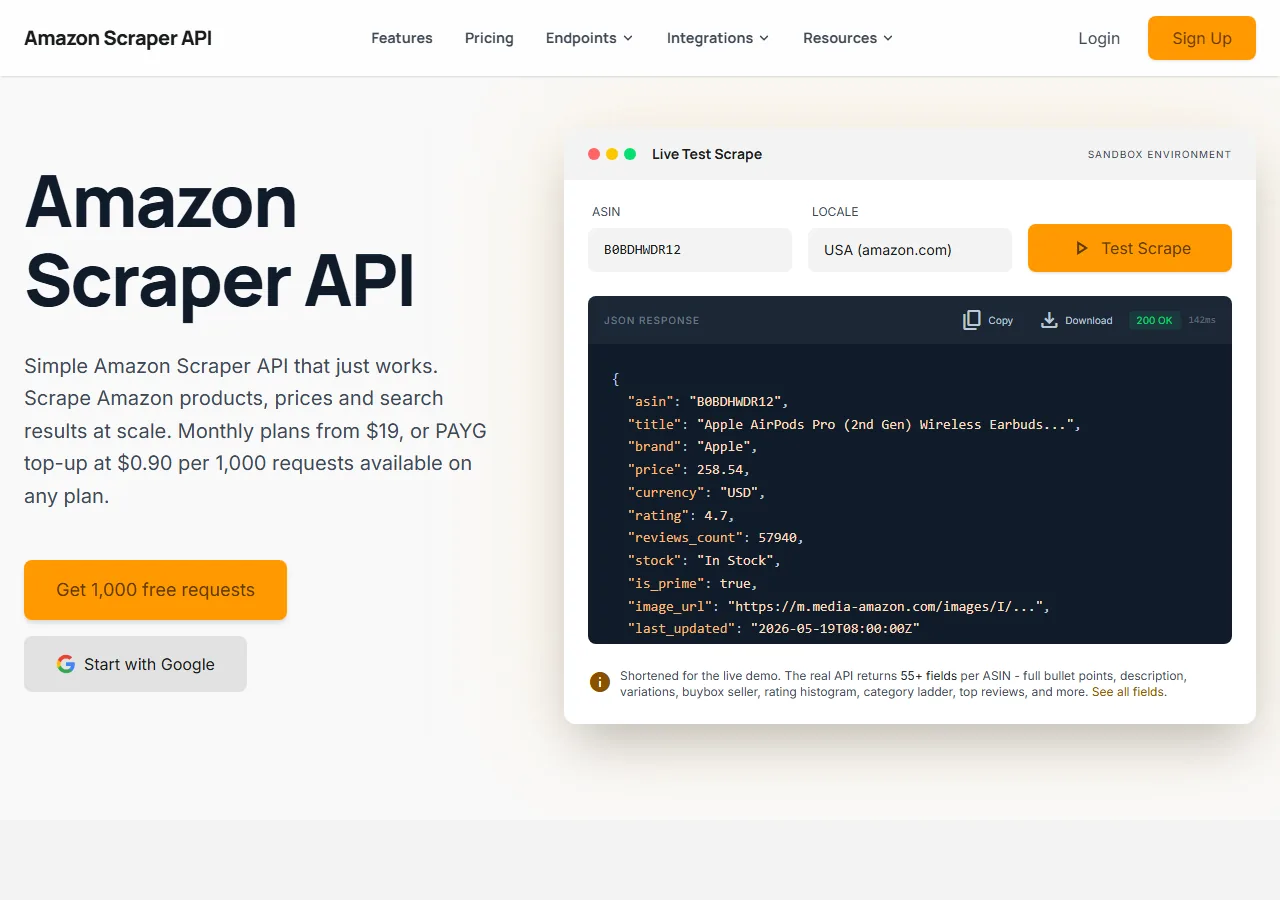
Amazon Scraper API is a purpose-built API for Amazon product, search, and review data, priced from $0.50 per 1,000 successful requests on Custom plans ($0.90 per 1,000 on pay-as-you-go). It targets teams that want Amazon-specific endpoints with explicit pay-per-success billing rather than the credit-multiplier pricing that general web scraping APIs apply to Amazon.
The product covers 20 Amazon marketplaces (US, UK, DE, FR, IT, ES, NL, PL, SE, CA, MX, BR, AU, JP, SG, IN, TR, AE, SA, EG). The sync endpoint accepts a single ASIN or product URL and returns clean HTML or structured JSON with around 55 product fields. The async batch endpoint takes up to 1,000 ASINs per POST and delivers results via signed webhook.
Pricing: From $0.50 per 1,000 on Custom plans, $0.90 per 1,000 on pay-as-you-go. 1,000 free on signup. Failed (non-2xx) requests are not billed.
Best for: Production workloads above 50,000 requests per month, MAP-compliance teams, repricing tools, AI agents that need an MCP server, and any team that wants explicit per-success billing rather than credit math.
Trade-offs: Newer to market than Bright Data and Oxylabs, so third-party benchmark coverage is thinner. JavaScript rendering and full paginated reviews are on the roadmap.
2. Bright Data
Bright Data is the largest commercial proxy and scraping vendor by revenue. Their Amazon Scraper sits on top of one of the largest residential proxy networks globally and returns the deepest field set in the niche.
AIMultiple’s 2026 benchmark measured Bright Data at 99.98% success with 686 fields per product (highest in the test). Response times averaged around 66 seconds (slowest in the test, reflecting the deeper extraction work). At scale, the efficiency works out to roughly 950 requests per dollar.
Pricing: Approximately $1.50 per 1,000 entry tier, dropping to around $0.90 per 1,000 at higher volume. Pay-as-you-go on the Web Scraper API for Amazon.
Best for: Enterprise teams that already buy Bright Data’s broader proxy stack, brand-protection use cases needing ZIP-level geo targeting, and high-compliance industries that require formal data-access agreements.
Trade-offs: Slowest measured response time in the AIMultiple benchmark. Pricing requires a sales call for Custom rates. The unstructured proxy product separately bills for bandwidth.
3. Decodo (formerly Smartproxy)
Decodo (rebranded from Smartproxy in 2025) ranked #1 in Proxyway’s 2025 Scraping API Report with a 99.5% success rate on Amazon, the highest of all providers benchmarked. Their entry tier is the cheapest of any tier-one provider in the table at $0.50 for 2,000 requests ($0.25 per 1,000).
AIMultiple’s benchmark measured their response time at 3 seconds (tied for fastest) with 286 average fields per product page. The pricing efficiency works out to roughly 800 requests per dollar.
Pricing: $0.25 per 1,000 on the Standard plan ($0.50 for 2K requests entry). Subscription, billed on successful requests.
Best for: Teams that need the highest measured success rate, mid-market workloads under 5TB/month, anyone who wants both proxies and a Web Scraping API from one vendor.
Trade-offs: Field count (286) is well below Bright Data (686) and Apify (577), so workflows needing every visible product field may need to combine Decodo with another provider.
4. Oxylabs
Oxylabs measured 98.14% success rate in Proxyway’s 2025 report. Their entry pricing is competitive at $49/month for 98,000 results ($0.50 per 1,000), with rates dropping below that at higher commitment.
Their advantage is a mature anti-bot stack on top of one of the largest residential proxy pools in Europe. Their proprietary OxyMouse module emulates browser interaction patterns that bypass several Amazon anti-bot signals beyond the IP layer.
Pricing: $0.50 per 1,000 entry ($49/month for 98K results). Subscription, billed on successful requests.
Best for: Teams scraping across many e-commerce targets beyond Amazon. EU-based teams that want vendor-resident infrastructure for GDPR purposes.
Trade-offs: The two-product split (proxies separate from Web Scraper API) means most workflows pay for both. Pricing transparency varies above the entry tier.
5. Zyte
Zyte (formerly Scrapinghub) measured 97.78% success rate in Proxyway’s 2025 report with the fastest tied response time at 3 seconds. Their pricing is credit-based on a calculator that works out to roughly $0.20 per 1,000 at low volume, dropping to over 2,000 requests per dollar at 12.5M requests/month per AIMultiple’s benchmark.
Field depth is the lowest of the benchmarked providers at 131 fields per product, reflecting Zyte’s tighter common-denominator schema philosophy.
Pricing: Calculator-driven; ~$0.20 per 1,000 at entry, scaling to ~$0.50 or less at very high volume.
Best for: Teams that prioritize speed (3-second response). High-volume workloads where the unit economics matter more than field depth.
Trade-offs: Fewer fields per product than the others (131 vs Bright Data’s 686). Pricing math is opaque without using the calculator.
6. ZenRows
ZenRows measured 98.51% success rate in Proxyway’s 2025 report. Their entry pricing is $69/month for 66,700 results, working out to roughly $1 per 1,000.
Pricing: $1 per 1,000 entry ($69/month for ~67K results). Credit-based subscription.
Best for: Teams that want an anti-bot-first scraping API with strong success rates and don’t need the deepest field set.
Trade-offs: Higher per-1,000 entry than Decodo, Oxylabs, or Zyte. Less Amazon-specific tooling than Bright Data or Amazon Scraper API.
7. ScrapingBee
ScrapingBee measured 97.05% success rate in Proxyway’s 2025 report. Their entry plan is $49/month for 50,000 requests (~$0.98 per 1,000). They were acquired by Oxylabs in early 2026.
Pricing: $0.98 per 1,000 entry ($49/month for 50K). Subscription with credit modifiers.
Best for: Workflows that already use ScrapingBee for JavaScript-heavy non-Amazon scraping and want to consolidate.
Trade-offs: Lower success rate than the top tier. JavaScript rendering on Amazon is rarely needed (the static HTML carries every public field), so paying for JS render is mostly waste.
8. Scrapingdog
Scrapingdog is a budget scraping API that publishes its own benchmarks claiming 99% success rate on Amazon (vendor-self-reported, not in the Proxyway 2025 set). Pricing is the most aggressive in the niche: $0.20 per 1,000 on their Pro plan, dropping to $0.063 per 1,000 at the highest volume tier.
Pricing: $0.20 per 1,000 (Pro), down to $0.063 per 1,000 at high volume.
Best for: Cost-sensitive teams running 100,000+ requests/month who can tolerate occasional retries and don’t need third-party benchmark coverage.
Trade-offs: Smaller proxy pool than Bright Data or Oxylabs. Vendor-self-reported success rate not directly comparable to Proxyway-measured numbers.
9. Scrape.do
Scrape.do is a Turkey-operated scraping API that publishes its own Amazon scraper API comparison claiming around 96 to 98% success rate (vendor-self-reported). Pricing is roughly $0.49 per 1,000 successful requests on their Pro plan.
Pricing: $0.49 per 1,000 (Pro), variable based on render mode.
Best for: Teams that want a transparent per-success rate with explicit render-mode control.
Trade-offs: Smaller team and shorter operating history than the top three. Not in the Proxyway 2025 benchmark set.
10. ScraperAPI
ScraperAPI is a general scraping API with dedicated Amazon endpoints. Pricing is $2.45 per 1,000 on the Hobby plan, dropping to $0.475 per 1,000 on Enterprise. Older AIMultiple benchmarks measured around 96% success rate, but they were not included in the Proxyway 2025 set.
Pricing: $2.45 per 1,000 (Hobby) to $0.475 per 1,000 (Enterprise).
Best for: Teams already running ScraperAPI for non-Amazon targets who want one provider for everything.
Trade-offs: Higher Hobby-tier pricing than most peers. Independent benchmarks are getting older as Proxyway and AIMultiple have shifted focus to other providers.
11. Apify
Apify is a platform for actor-based scrapers, not a pure API. Their pre-built Amazon Product Scraper, Amazon Review Scraper, and Amazon Seller Scraper run as serverless jobs and return JSON, XML, CSV, or Excel.
AIMultiple’s benchmark measured Apify at the deepest non-Bright-Data field count (577 fields per product) and ~15-second response time. Their pricing model is the most expensive in the niche at approximately $6.67 per 1,000 product requests on the Standard plan.
Pricing: ~$6.67 per 1,000 on the Standard plan with $5/month free credit. Compute-time billed.
Best for: No-code teams, one-off ad-hoc scrapes, anyone who wants to run scrapers on a schedule without writing infrastructure.
Trade-offs: Most expensive per request. Compute-time billing means a slow scrape costs more than a fast one even if both succeed.
12. DIY Python plus Residential Proxies
The fully self-hosted option: Python plus curl_cffi for TLS fingerprint impersonation, plus a residential proxy provider (Webshare, Evomi, Decodo) at around $4 per GB.
A 100k-ASIN job at 250KB per response averages roughly 25GB of bandwidth, or $100 in proxy cost, plus engineering time to build and maintain the scraper. Success rates run 60 to 90% depending on the proxy provider, the fingerprint stack, and ongoing maintenance. At small volume (under 5,000 ASINs/month) this is cheaper than any commercial API. Above that, the engineering and incident-response cost passes the breakeven against a managed scraper.
Pricing: ~$4 per GB residential bandwidth, plus engineering time.
Best for: Single-developer projects scraping fewer than 5,000 ASINs per month, or teams that want full control of the request stack for compliance reasons.
Trade-offs: You own the maintenance burden when Amazon changes its anti-bot stack (which it does roughly every 4 to 8 weeks).
How to Choose an Amazon Scraper
The decision tree most buyers should follow:
For 50,000+ ASINs per month at the cheapest price: Decodo at $0.25 per 1,000 entry plus 99.5% success or Zyte at ~$0.20 per 1,000 plus 97.78% success are the public-pricing leaders. Negotiate Custom plans at higher volume.
For premium proxy depth and the highest measured success rate: Bright Data at 99.98% and 686 fields per product. Pricier but the network depth shows on the tail of difficult targets.
For pay-per-success billing with Amazon-specific tooling: Amazon Scraper API ships an MCP integration and explicit per-success billing from $0.50 to $0.90 per 1,000.
For no-code or scheduled scraping, occasional ad-hoc: Apify. The actor model fits one-off jobs better than a per-success API, despite being the most expensive in the table.
For under 5,000 ASINs per month: the DIY Python plus curl_cffi plus residential proxies path is cheapest, as long as you accept the maintenance burden when Amazon rotates its anti-bot signals.
What’s the Cheapest Amazon Scraper API?
At public entry-tier pricing, Zyte’s calculator lands around $0.20 per 1,000 and Scrapingdog’s Pro plan is also $0.20 per 1,000 (vendor pricing, not Proxyway-benchmarked). Decodo’s $0.50 for 2,000 requests entry works out to $0.25 per 1,000, with the 99.5% Proxyway-measured success rate behind it.
At very high volume (multi-million requests/month), Zyte drops to over 2,000 requests per dollar and Scrapingdog drops to $0.063 per 1,000 (vendor self-published).
Amazon Scraper API Custom plans start at $0.50 per 1,000 (from $100/month). Pay-as-you-go is $0.90 per 1,000 with 1,000 free on signup. The “cheapest” tag depends on volume tier and whether you’re optimizing for entry-tier price or fully-loaded TCO including success rate.
What’s the Most Reliable Amazon Scraper?
Bright Data measured 99.98% success rate in the AIMultiple 2026 benchmark (1,400 URLs across 7 Amazon domains), highest in the test. Decodo measured 99.5% in the Proxyway 2025 Scraping API Report, highest in that benchmark. ZenRows measured 98.51%. Oxylabs measured 98.14%. Zyte measured 97.78%.
The 1.5-percentage-point spread between top and bottom in the Proxyway tier is small enough that vendor choice often comes down to pricing and field depth rather than success rate alone. Reliability also changes with Amazon’s anti-bot pressure, which spikes around Prime Day and Black Friday; vendors with deeper residential pools (Bright Data, Oxylabs, Decodo) handle those spikes better than vendors with thinner pools.
Vendor-self-reported numbers (Scrapingdog 99%, Scrape.do 96-98%) come from those vendors’ own benchmarks, not from Proxyway or AIMultiple, and are not directly comparable.
FAQ
Which Amazon scraper has the best free tier?
Amazon Scraper API gives 1,000 free successful requests on signup, no credit card. Apify gives $5/month in platform credit (roughly 750 Amazon requests). ScraperAPI gives 1,000 free credits but Amazon scrapes typically cost 5 credits each, working out to 200 free Amazon requests. Most other vendors offer 7 to 14 day trials rather than a permanent free tier.
Can I scrape Amazon without an API?
Yes, with Python plus curl_cffi plus residential proxies. The setup is around 100 lines of code plus ongoing maintenance when Amazon rotates its anti-bot stack. For under 5,000 ASINs per month and a developer who enjoys the work, this is the cheapest path. For production workloads or teams without dedicated scraping engineers, a managed API costs less when total cost of ownership (engineering time plus proxy bandwidth plus incident response) is included.
Do Amazon scrapers support all 20 Amazon marketplaces?
Most paid Amazon scrapers cover 18 to 20 marketplaces. Coverage gaps tend to appear in the smaller ones: Egypt (amazon.eg), Saudi Arabia (amazon.sa), and Turkey (amazon.com.tr). Amazon Scraper API covers all 20 including Egypt. Bright Data and Oxylabs cover them all. Apify and ScraperAPI cover 18 to 19. ScrapingBee covers 15.
What does “pay-per-success” mean in Amazon scraping pricing?
Pay-per-success means failed requests (Amazon CAPTCHA pages, 5xx errors, timeouts) do not consume credits. Pay-per-request bills every attempt regardless of outcome. Pay-per-success matters most during anti-bot escalations, when failure rates can spike from 2% to 30% in a single hour. With pay-per-success, your bill stays flat against your successful results. With pay-per-request, your bill spikes alongside your failures.
Is using an Amazon scraper API legal?
Scraping publicly visible Amazon product data is generally legal in the US under the Ninth Circuit hiQ vs LinkedIn precedent, which held that public-web scraping does not violate the Computer Fraud and Abuse Act. It does not override Amazon’s Terms of Service, which are a contract matter rather than criminal. See our scraping Amazon legality guide for the full breakdown.
Which Amazon scraper has an MCP server for AI agents?
Amazon Scraper API ships an official MCP server that drops into Claude Desktop, Cursor, or any MCP-compatible AI client. Bright Data, Apify, and ScraperAPI have community-built MCP servers but no official ones at time of writing. For teams building AI agents that need Amazon product data, the MCP-first vendors are the path of least friction.
How was the success rate data verified?
Two third-party benchmark sources are cited in this comparison: the Proxyway 2025 Scraping API Report and the AIMultiple Amazon scraper benchmark (1,400 URLs across amazon.com, .co.uk, .de, .fr, .it, .es, .ca). Vendor-self-reported numbers (Scrapingdog 99%, Scrape.do 96-98%) are flagged as such because their methodology and test set are different from the Proxyway and AIMultiple benchmarks. Different benchmarks weight failures differently and use different ASIN sets, so absolute numbers across sources are not directly comparable.